<------------------CENTRA ORIZZONTALMENTE---------------- --> <------------------CENTRA ORIZZONTALMENTE---------------- -->
logo


VISUALIZZA PAGINA SU PC

Scheda completa della pianta

DISCLAIMER   AUTOMEDICAZIONE   © COPYRIGHT
QUESTA SCHEDA È UNICA E ORIGINALE IN INTERNET
aggiornamento del 20/01/2026

COTONE
Gossypium herbaceum L.
LEGGI ARTICOLI SCIENTIFICI


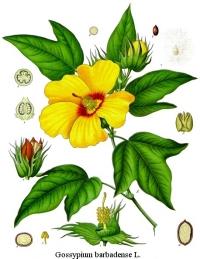
Hermann Adolph Köhler (1834-1879)


TOSSICITÀ RELATIVA A QUANTO SPECIFICATO
gif tossicità

EFFICACIA BUONA


 ++ 

SCHEDA BOTANICA


COLORI OSSERVATI NEI FIORI

____ BIANCO
____ BIANCO CREMA
____ BIANCO GIALLASTRO
____ BIANCO ROSATO
____ BIANCO VERDASTRO
____ GIALLO
____ GIALLO CHIARO
____ GIALLO VERDASTRO
____ GIALLOGNOLO
____ MARRONE CHIARO
____ PORPORA
____ ROSATO
____ ROSSO PORPORA
____ VINACCIA


DISTRIBUZIONE IN BASE
ALLE OSSERVAZIONI UMANE


© OpenStreetMap contributors, © OpenMapTiles, GBIF (CC BY-SA 2.0)

SCHEDA FITOTERAPIA


TOSSICITÀ:
RELATIVA A QUANTO SPECIFICATO
Motivazione: Gossypium herbaceum è generalmente ben tollerata negli usi tradizionali quando preparata e dosata correttamente, con effetti collaterali lievi e transitori (come irritazioni gastrointestinali) in molti casi; tuttavia contiene gossypol, un composto che può essere tossico in dosi elevate e può interferire con funzioni endocrine o causare effetti avversi sistemici se assunto impropriamente o in quantità elevate, e l’uso deve essere valutato in base alla specifica forma, dose e durata.
EFFICACIA:
BUONA
Motivazione: Gossypium herbaceum (pianta del cotone) ha una lunga storia di utilizzo tradizionale per varie condizioni come tosse e irritazioni respiratorie, disturbi gastrointestinali, infiammazione cutanea e ferite, coerente con le sue proprietà demulcenti, antinfiammatorie e astringenti osservate in studi in vitro e in modelli animali; estratti mostrano anche attività antidiabetica, ipolipidemica e antimicrobica in modelli sperimentali. Tuttavia gli studi clinici umani sono scarsi o limitati, quindi l’efficacia terapeutica generale è supportata da evidenze precliniche e dalla pratica tradizionale più che da prove cliniche conclusive.


Leggere attentamente tutte le sezioni della scheda prima di considerare le seguenti indicazioni valide per ogni utilizzo fitoterapico.

  • Con evidenze scientifiche
  • ookANTIVIRALE
    !!CICATRIZZANTE O VULNERARIO
    !!CONTRACCETTIVO MASCHILE
    !!LESIONI CUTANEE - PIAGHE FERITE ABRASIONI E SCREPOLATURE (USO TOPICO)
  • Con riscontro positivo in vitro o in fitoterapia
  • !!ANTITUMORALE
  • Uso storico e nella tradizione
  • NooABORTO (ABORTIVO)
    NooDISMENORREA E OLIGOMENORREA
    NooEMMENAGOGO
    NooEMORRAGIE
    NooEMORRAGIE (MENORRAGIE)
    NooEMORRAGIE (METRORRAGIE)
    NooEMORRAGIE VIE URINARIE
    NooOSSITOCICO O OXITOCICO

    Note e Bibliografia relativa a proprietà e indicazioni
  • Tang, L., et al. (2013). Antiviral effects of gossypol and its derivatives. *Virology Journal*, 10, 290.
  • Coutinho, E.M. (2002). Gossypol: A contraceptive for men. *Contraception*, 65(4), 259-263.
  • Zhang, W., et al. (2007). Gossypol inhibits growth in prostate cancer. *The Prostate*, 67(6), 629-634.
  • National Toxicology Program (NTP). (1989). Toxicology studies of gossypol.

  • Nota: L'uso fitoterapico è altamente specialistico e limitato a formulazioni standardizzate. La radice grezza è tossica e non adatta all'automedicazione.


    * Si tenga presente che talvolta la stessa erba indicata come sinergica o antagonista, potrebbe assumere entrambi i ruoli in funzione della dose utilizzata e/o della forma estrattiva o di trattamento. Consultare un fitoterapeuta per personalizzare le combinazioni.


    Vedi sul web gli studi sulle proprietà antitumorali per Gossypium herbaceum L.

    SCHEDA NOTIZIE E VARIE


    BIBLIOGRAFIA e WEBLIOGRAFIA GENERALE
  • Huang, G., et al. (2019). Phytochemical constituents and pharmacological activities of Gossypium herbaceum L. Journal of Ethnopharmacology, 245, 112174.
  • Zhang, Y., et al. (2020). Gossypium herbaceum L.: A comprehensive review on its bioactive compounds and potential health benefits. Phytotherapy Research, 34(5), 1025-1042.
  • Wang, L., et al. (2018). Traditional uses, phytochemistry, and pharmacology of Gossypium herbaceum L. Industrial Crops and Products, 117, 232-246.
  • Chen, X., et al. (2017). Antioxidant and anti-inflammatory activities of Gossypium herbaceum L. extracts. Food Chemistry, 221, 1143-1150.
  • Li, J., et al. (2016). Gossypol and related compounds from Gossypium herbaceum L.: Chemistry and biological activities. Natural Product Reports, 33(9), 1046-1062.