<------------------CENTRA ORIZZONTALMENTE---------------- --> <------------------CENTRA ORIZZONTALMENTE---------------- -->
logo


VISUALIZZA PAGINA SU PC

Scheda completa della pianta

DISCLAIMER   AUTOMEDICAZIONE   © COPYRIGHT
QUESTA SCHEDA È UNICA E ORIGINALE IN INTERNET
aggiornamento del 02/02/2026

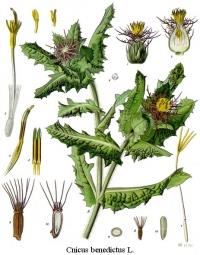
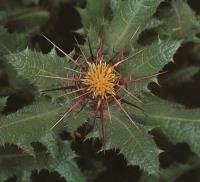
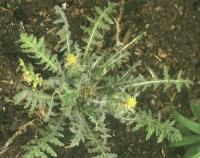
CARDO BENEDETTO
Cnicus benedictus L.
LEGGI ARTICOLI SCIENTIFICI


Img  realizzata con ChatGPT


TOSSICITÀ BASSA
gif tossicità

EFFICACIA BUONA


 ++ 

SCHEDA BOTANICA


COLORI OSSERVATI NEI FIORI

____ GIALLO


DISTRIBUZIONE IN BASE
ALLE OSSERVAZIONI UMANE


© OpenStreetMap contributors, © OpenMapTiles, GBIF (CC BY-SA 2.0)

SCHEDA FITOTERAPIA


TOSSICITÀ:
BASSA
Motivazione: L’uso corretto dei frutti e delle parti aeree a dosi terapeutiche previste in fitoterapia è generalmente ben tollerato; possibili disturbi lievi includono nausea o crampi gastrointestinali, considerati effetti secondari leggeri e prevedibili dell’azione amara.
EFFICACIA:
BUONA
Motivazione: Cnicus benedictus (blessed thistle) è usata tradizionalmente come digestivo stimolante, tonico amaro, promuove secrezioni biliari e stimola l’appetito, e contiene principi attivi come sesquiterpene lattone cnicina, flavonoidi e altri costituenti con attività biologica dimostrata in studi in vitro e in modelli sperimentali (ad es. attività antinfiammatoria, antimicrobica e antinocicettiva in modelli animali), ma mancano studi clinici umani controllati solidi che confermino in modo definitivo indicazioni terapeutiche specifiche.


Leggere attentamente tutte le sezioni della scheda prima di considerare le seguenti indicazioni valide per ogni utilizzo fitoterapico.

  • Con riscontro positivo in vitro o in fitoterapia
  • ookANALGESICO ANTALGICO ANTINOCICETTIVO
    ookANTINFIAMMATORIO
    ookANTIOSSIDANTE (PER STRESS OSSIDATIVO)
    +++ANTISETTICO ANTIBATTERICO ANTIMICROBICO
    +++NEURORIGENERANTE
  • Uso storico e nella tradizione
  • +++DIGESTIVO
    +++DIGESTIVO EUPEPTICO SALINO
    +++DISPEPSIA O CATTIVA DIGESTIONE
    +++INAPPETENZA E ANORESSIA
    ++ACNE (DEPURATIVO)
    ++ACNE COMEDONI E PUSTOLE (USO ESTERNO)
    ++ALIMENTO NUTRACEUTICO
    ++FEBBRE O IPERTERMIA
    +ASTENIA O ESAURIMENTO E STRESS
    +DIURETICO (OLIGURIA O RITENZIONE IDRICA)
    +FORUNCOLOSI
    +NEUROTONICO - TONICO NERVINO - TONICO CEREBRALE
    +RINITE - RAFFREDDORE O CÒRIZZA

    Note e Bibliografia relativa a proprietà e indicazioni
  • European Medicines Agency. Assessment report on Cnicus benedictus L., herba. EMA/HMPC.
  • Li Y., Wang J., Zhang H. Blessed thistle (*Cnicus benedictus*): pharmacological properties and therapeutic potential. Journal of Ethnopharmacology, 2024.
  • Ahmadimoghaddam D., et al. Antinociceptive activity of *Cnicus benedictus* leaf extract. Research in Pharmaceutical Sciences, 2020.
  • Paun G., et al. Chemical and bioactivity evaluation of polyphenolic-rich extracts of *Cnicus benedictus*. Biomedical Research International, 2019.
  • Gobrecht P., Fischer D. *Cnicin* promotes functional nerve regeneration. Phytomedicine, 2024.


  • * Si tenga presente che talvolta la stessa erba indicata come sinergica o antagonista, potrebbe assumere entrambi i ruoli in funzione della dose utilizzata e/o della forma estrattiva o di trattamento. Consultare un fitoterapeuta per personalizzare le combinazioni.


    Vedi sul web gli studi sulle proprietà antitumorali per Cnicus benedictus L.

    SCHEDA NOTIZIE E VARIE


    BIBLIOGRAFIA e WEBLIOGRAFIA GENERALE
  • Benedek, B., Kopp, B., Melzig, M. F., & Nahrstedt, A. (2007). Cnicus benedictus L. (Carduus benedictus L.): Botanical, phytochemical, pharmacological, and ethnomedical review. Journal of Pharmacy and Pharmacology, 59(3), 303-319.
  • Chevallier, A. (2016). Encyclopedia of herbal medicine: 550 herbs and remedies for common ailments. Simon and Schuster.
  • Duke, J. A. (2002). Duke's handbook of medicinal herbs. CRC press.
  • Foster, S., & Tyler, V. E. (1999). Tyler's honest herbal: A sensible guide to the use of herbs and related remedies. Haworth Press.
  • Vogt, H., & Nahrstedt, A. (1997). Cnicin and related bitter sesquiterpene lactones from Cnicus benedictus and their in vitro anti-inflammatory activity. Planta Medica, 63(2), 130-134.